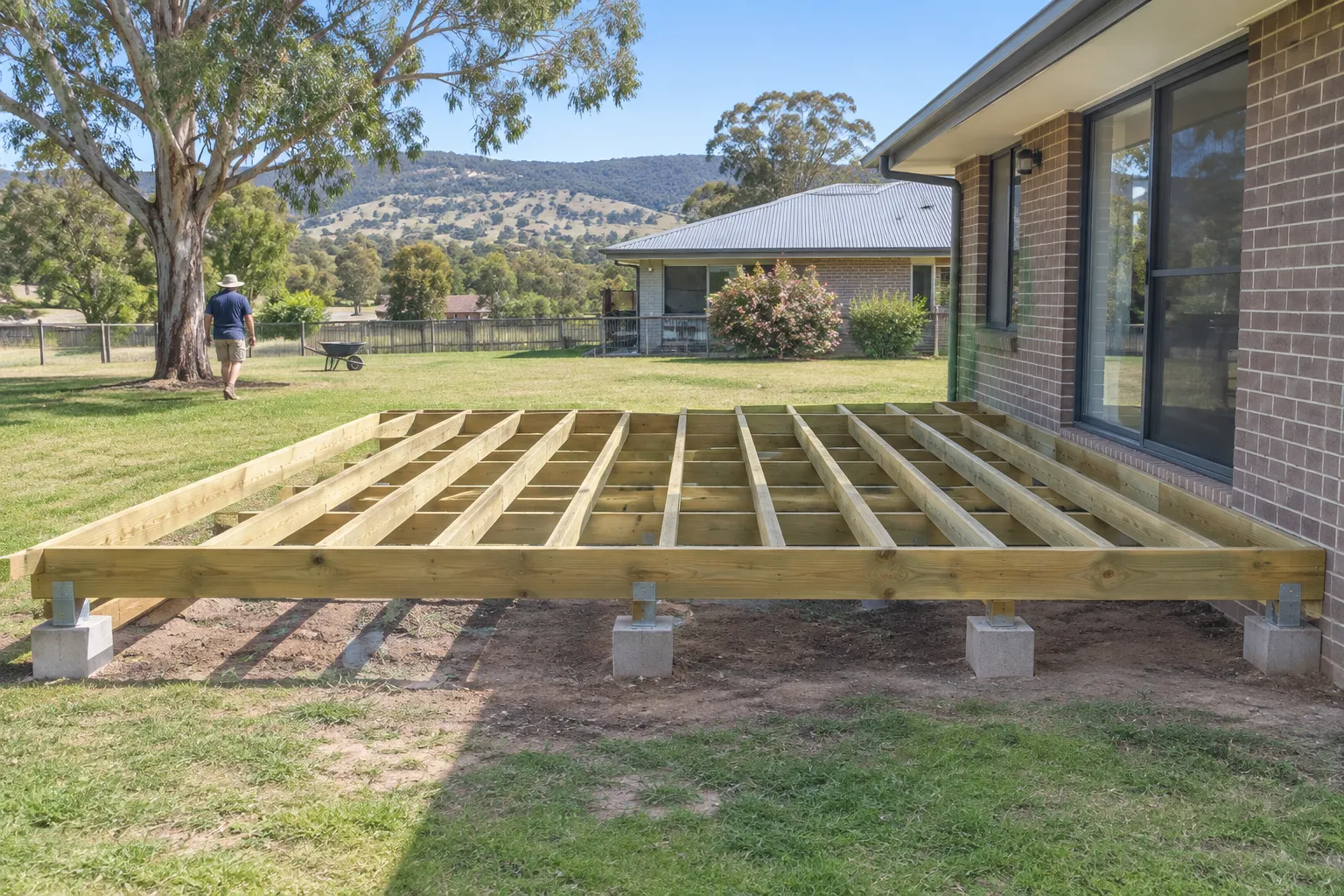
Decking frame timber is the structural timber under the boards: bearers that sit on the posts, and joists that sit on the bearers and carry the decking. Most frames around Albury use treated pine in a structural grade, such as MGP10 or MGP12, treated to H3 for ventilated frames or H4 for frames close to the ground. Sizes come from span tables for the grade, spacing and span. For a frame that won't rot, see our main deck framing, joists and footings page on steel framing.
Which timber is used for deck frames?
Treated pine is the most common deck frame timber in Australia, because it's affordable, consistent and easy to work. Hardwood frames are used too, especially on older or heritage decks. Each piece needs the right hazard class for its exposure, and the right stress grade for its span. Steel is the main alternative to timber.
| Frame material | Pros | Watch out for |
|---|---|---|
| Treated pine (MGP grades) | Affordable, consistent | Right hazard class, sealed cut ends |
| Hardwood | Strong, durable species | Cost, availability, weight |
| Galvanised steel | No rot or termites | Cost, coating care |
What do MGP10 and MGP12 mean?
MGP stands for machine graded pine. The number is the stress grade: MGP12 is stiffer and stronger than MGP10, so it can span further at the same size. Span tables are published for each grade. Using the grade the tables assume matters, because a lower grade at the same size may sag or bounce.
Which hazard class should frame timber be?
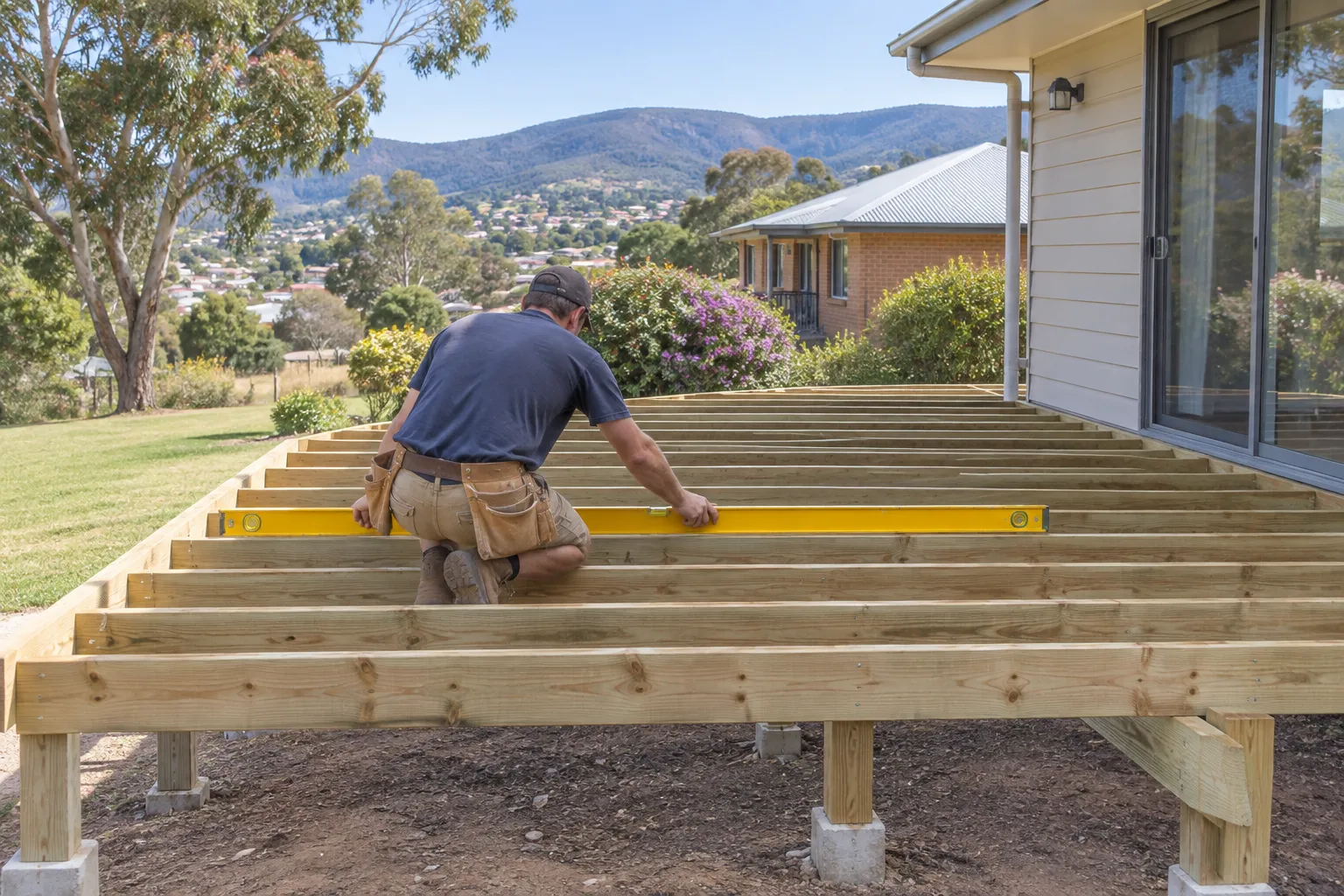
Use H3 treated pine for frames above ground with good airflow, H4 for frames that sit low or stay damp, and H5 for anything in contact with the soil, such as posts. WoodSolutions says decks with less than 400 millimetres of clearance should use H4 treated pine or a class 1 hardwood. Treated timber should carry a stamp showing its class.
How do span tables work?
A span table tells you how far a joist or bearer of a given size, grade and spacing can safely span between supports. You look up the grade, the timber size and the spacing, and read off the maximum span. Tables also distinguish single spans, over two supports, from continuous spans, over three or more, which can carry more.
To use one:
- Pick the grade of timber you're buying, such as MGP10.
- Choose the spacing, such as joists at 450 millimetres.
- Find the span you need between bearers.
- Read off the size that achieves it, such as 140 by 45.
Treated pine suppliers publish span tables for decks, and the Australian timber framing standard sets the rules behind them.
What size joists and bearers are common?
Common treated pine joists are 90 by 45, 140 by 45 and 190 by 45 millimetres, usually at about 450 millimetre centres for standard boards. Bearers are often 140 by 45 doubled, 190 by 45 or larger. Deeper timber spans further. The final sizes depend on your deck's spans and grade.
See treated pine decking sizes.
Can hardwood be used for deck joists?
Yes. Durable hardwoods can be used for joists and bearers, and some decks use hardwood throughout. Hardwood frames are heavier, cost more and are less common now than treated pine or steel. Span tables exist for hardwood grades too. Merbau, for example, is class 1 above ground but only class 3 in the ground, so it shouldn't be used for posts in the soil.
How do you make frame timber last?
Use the right hazard class for each part, seal every cut end with an end-seal product, use hot-dipped galvanised or stainless fixings rated for treated timber, keep airflow under the deck, keep soil and leaves away from the timber, and make sure water drains away. Or use a galvanised steel frame. See how long a deck frame lasts and steel deck framing vs wood.
Questions people ask
What timber is best for deck joists?
For most decks, H3 treated pine in a structural grade like MGP10 or MGP12 is the standard choice, stepping up to H4 for low or damp frames. Galvanised steel joists are the longest-lasting option. Hardwood joists work but cost more. The grade and size must match the span table for your deck.
How far can a joist span on a deck?
It depends on the timber size, grade, spacing and whether it's a single or continuous span, so there isn't one figure. Span tables give the answer. As a rule, deeper joists and higher grades span further, and closer spacing helps. A builder sizes the frame from the tables for your deck.
Do deck bearers need to be doubled?
Not always. Doubling two pieces of timber together is a common way to make a bearer strong enough for a longer span or heavier load, using standard sizes. A single deeper bearer can do the same job. The span tables show which options work for your deck's spans and spacing.
Is H3 treated pine OK for deck joists?
H3 is suitable for deck joists that are above ground with good ventilation, where the timber gets wet but dries out. For decks with less than 400 millimetres of clearance, or in damp spots with poor airflow, WoodSolutions recommends H4 or a class 1 hardwood. Posts in the ground need H5.
The rest of our guides start from deck builder in Albury.
Where these facts come from
Updated