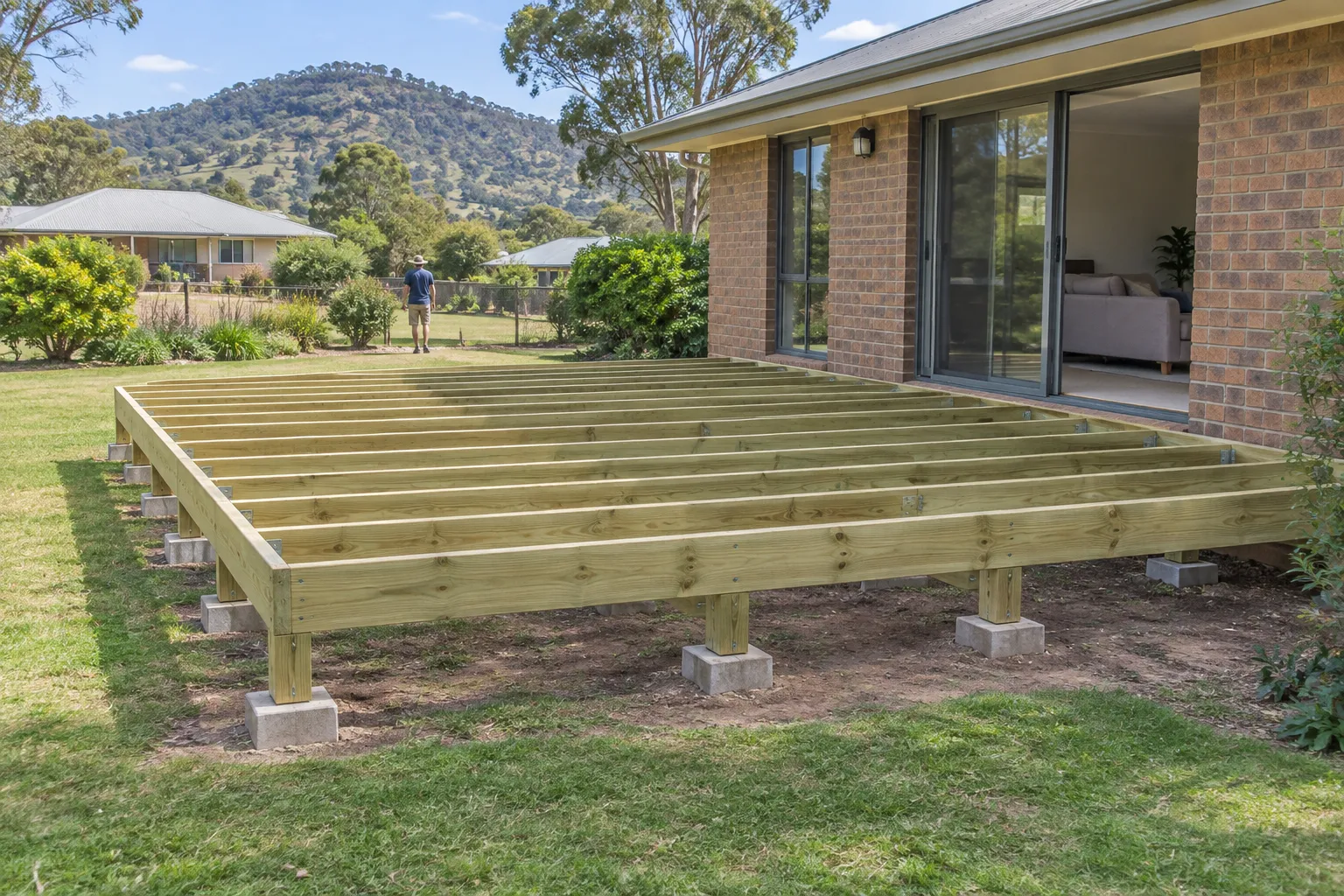
A deck frame lasts as long as its materials and detailing allow. A treated pine frame with the right hazard class, sealed cut ends and good airflow can last decades, but one with H3 timber close to damp ground can rot within years. Galvanised steel frames don't rot or attract termites, so they usually outlast the boards. Frames fail first on many decks because they sit low, stay damp and are never inspected. For how steel framing works and how joists are spaced, see our main deck framing, joists and footings page.
How long does a treated pine deck frame last?
A treated pine frame can give long service when each part has the right treatment for its exposure: H3 above ground with good airflow, H4 for frames close to the ground or that stay damp, and H5 or concrete for anything in the soil. WoodSolutions says decks with less than 400 millimetres of clearance should use H4 or a class 1 hardwood. Get that wrong and the frame shortens the deck's life.
| Frame part | Right treatment | What happens if it's wrong |
|---|---|---|
| Joists and bearers, well ventilated | H3 | Generally fine |
| Low frames under 400 mm clearance | H4 | H3 here can rot early |
| Posts in the ground | H5, or steel and concrete | H3 or H4 in soil rots |
How long does a steel deck frame last?
A galvanised steel deck frame doesn't rot, warp or get eaten by termites, so above ground it typically outlasts the decking boards on it. Its life depends on the coating and the conditions: frames sitting in pooled water, buried in soil, or near the coast corrode faster. Touching up cut ends and scratches with zinc-rich paint keeps the coating intact.
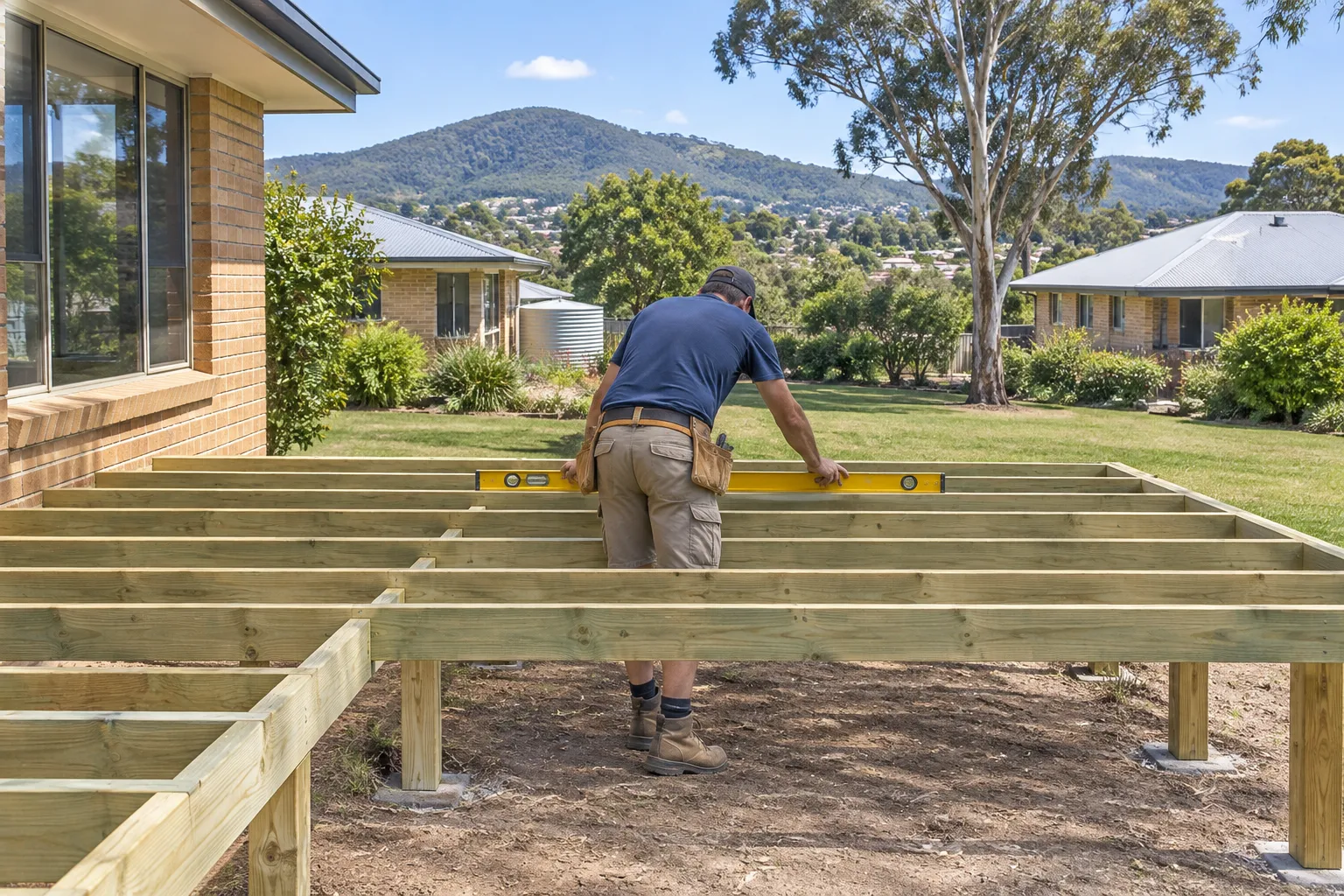
Steel is also non-combustible, which helps on bush fire prone land, as the Australian Steel Institute notes. See steel deck framing vs wood.
What makes a deck frame fail early?
The common causes are the wrong treatment class for the exposure, cut ends left unsealed, poor airflow under low decks, water pooling against posts, soil or leaf build-up against the timber, rusted fixings, and footings that move in Albury's reactive clay. Termites are another risk where timber is close to the ground.
Each one is cheap to avoid at the build stage and expensive to fix later.
How do you check if a deck frame is failing?
Look under the deck with a torch, and push a screwdriver into the joists, bearers and posts, especially near the ground and where water collects. Sound timber resists. Soft, spongy or crumbly timber is rotting. Check for sagging, loose or rusty bolts and brackets, posts that have tilted, and signs of termites, such as mud tubes.
What to check, from the ground up:
- Footings and posts. Sunk, tilted or rotting at ground level.
- Bearers. Soft spots, splits, sagging.
- Joists. Soft ends, rot where boards are fixed.
- Fixings. Rusted bolts, loose brackets, popped nails.
- Termites. Mud tubes, hollow-sounding timber.
If you find a problem, see signs of termites in a deck or repair or replace deck boards.
Can you replace a deck frame but keep the boards?
Sometimes. If the boards are in good condition and can be lifted without too much damage, a builder can replace or repair the frame and relay them. Hardwood boards that were screwed down can split when lifted, and some will need replacing. Composite boards on clips are easier to lift and relay. It's often a good time to switch to a steel frame.
Does a hardwood frame last longer than pine?
A class 1 hardwood frame can last a long time above ground, and Business Queensland rates spotted gum heartwood class 1 above ground and class 2 in the ground. Hardwood frames are less common today because treated pine and steel are cheaper and easier to work. For anything touching the soil, treated pine to H5, steel or concrete is the usual choice.
How do you make a deck frame last?
Use the right treatment class for each part, seal every cut end of treated pine, use hot-dipped galvanised or stainless fixings, keep good airflow under the deck, keep soil and leaves away from the timber, make sure water drains away, and inspect underneath every few years. Or use a galvanised steel frame from the start. See decking frame timber.
Questions people ask
How long do deck joists last?
Deck joists last as long as their treatment and conditions allow. Treated pine joists with the right hazard class, sealed ends and good airflow can last decades. Joists close to damp ground with too little treatment can rot within years. Galvanised steel joists don't rot and usually outlast the boards above them.
Is it worth replacing a timber frame with steel?
If the timber frame is failing anyway, replacing it with steel is often worth considering, especially for low decks, composite boards or bush fire prone land. Published guides put steel at roughly $60 to $120 a square metre more than treated pine. It won't need replacing when the boards eventually do. See steel deck framing cost.
Why are my deck joists rotting?
Joists usually rot because they stay wet: low clearance, poor airflow, leaves and soil against the timber, water pooling, or the wrong treatment class for a damp spot. Unsealed cut ends let water into untreated timber inside. Fixing airflow and drainage slows it, but rotten joists need replacing to keep the deck safe.
How often should you inspect a deck frame?
Look under the deck every couple of years, and after any very wet winter, flood or sign of termites nearby. Older decks deserve a check every year. A quick look with a torch and a screwdriver catches most problems early, when a single joist or post can be replaced instead of the whole frame.
For the wider picture, start with Border Outdoor Living deck builder.
Where these facts come from
Updated