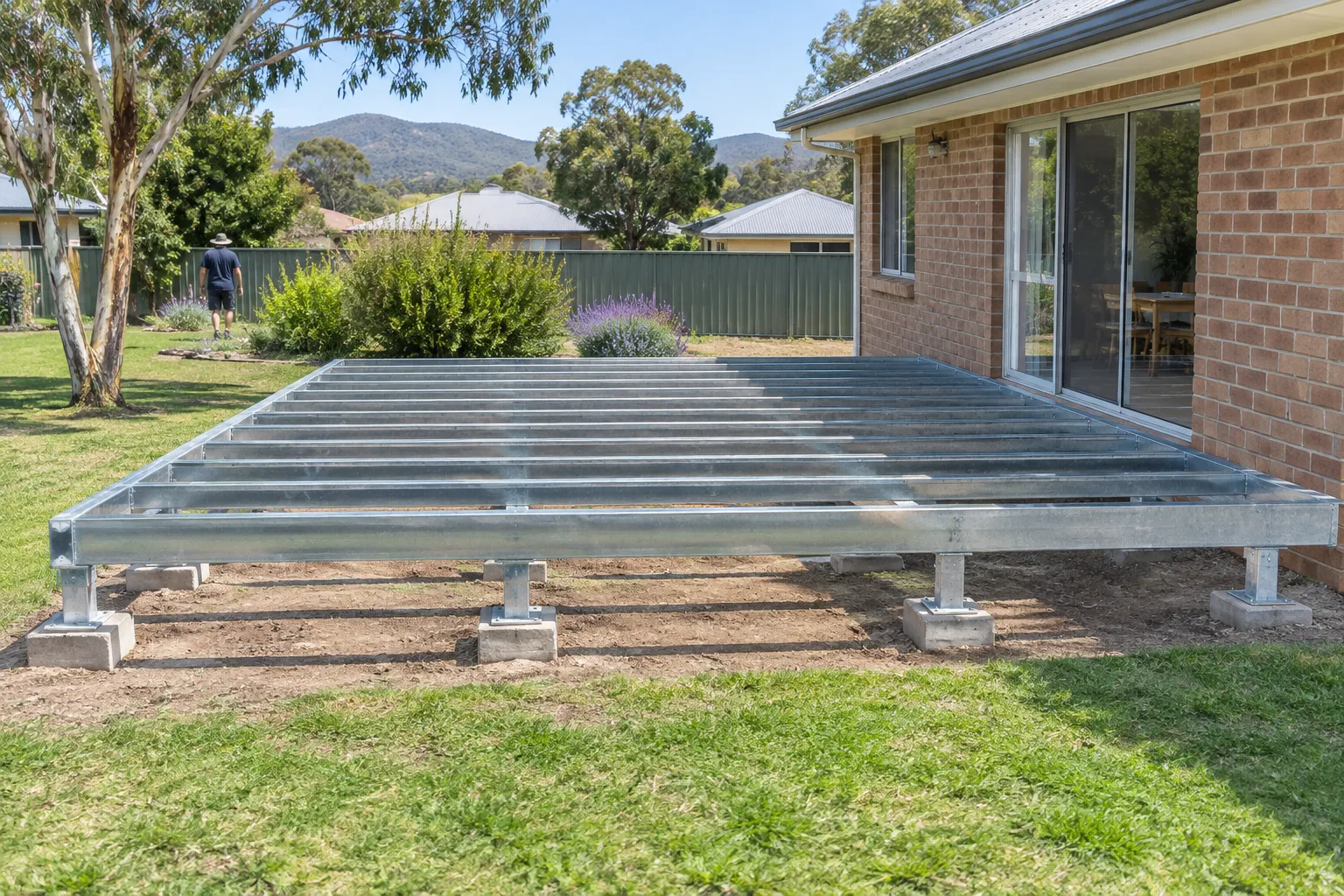
A galvanised steel deck frame costs more than a treated pine frame, roughly $60 to $120 a square metre extra in published Australian guides, but it doesn't rot, warp or attract termites, spans further with fewer posts, stays straighter under composite boards, and is non-combustible, which helps on bush fire prone land. A well-built treated pine frame with the right hazard classes is cheaper and easier to adapt on site. The deck's height, site and board choice usually decide it. For how steel framing works, see our main deck framing, joists and footings page.
How do steel and timber deck frames compare?
Steel's advantages are durability and stability. Timber's are cost and flexibility. On a low, damp or bushfire-prone site, or under composite boards, steel's advantages count for more. On a small, high, well-ventilated deck on a budget, timber often makes more sense.
| Galvanised steel frame | Treated pine frame | |
|---|---|---|
| Extra cost | About $60 to $120 per m2 more | Baseline |
| Rot | None | Possible if wrong class or damp |
| Termites | Not eaten | Treated, but a risk near ground |
| Warping and twisting | Stays straight | Can twist as it dries |
| Spans | Longer, fewer posts | Shorter for the same depth |
| Bushfire | Non-combustible | Combustible |
| On-site changes | Less flexible | Easy to cut and adjust |
Which lasts longer: steel or timber?
A galvanised steel frame above ground usually outlasts a timber frame, and often outlasts the boards on it, because it doesn't rot or get eaten by termites. A treated pine frame can last decades with the right hazard class, sealed cut ends and good airflow, but frames that sit low or stay damp can rot much sooner. WoodSolutions advises H4 for clearances under 400 millimetres.
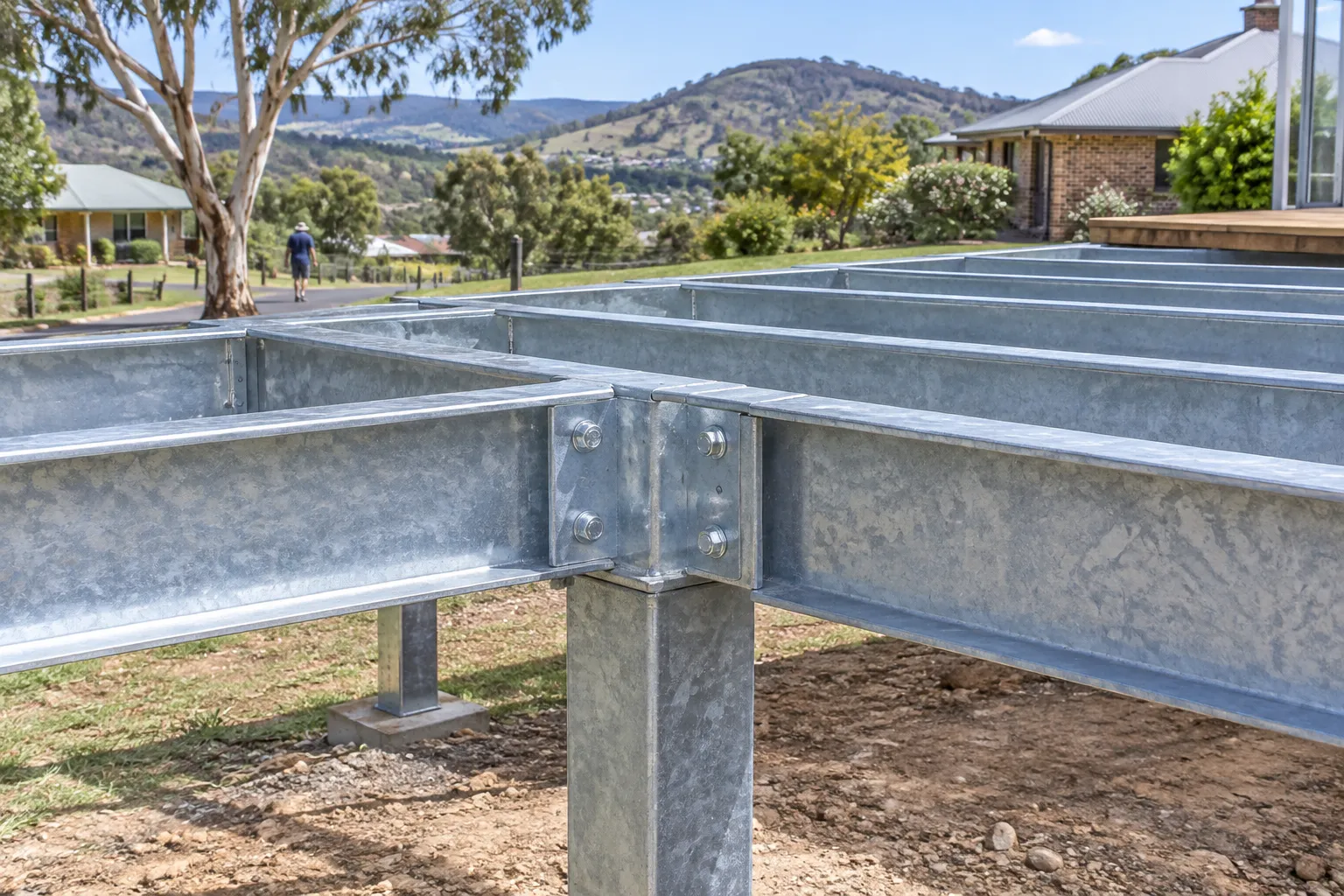
See how long a deck frame lasts.
Which is better under composite decking?
Steel is often the better partner for composite. Composite boards need a flat, straight frame at the brand's joist spacing, and steel doesn't twist or shrink as timber can when it dries. A twisted timber joist can show through composite boards as a ridge or a dip. Treated pine still works well under composite when it's straight, dry and well built.
Which is better on bush fire prone land?
Steel. It's non-combustible, and the Australian Steel Institute notes that steel construction adds resilience at higher bushfire attack levels. Parts of Thurgoona, Splitters Creek and Jindera are mapped as bush fire prone land. On those blocks, a steel frame with a bushfire-resisting timber or a tested board can make it simpler to meet the rules.
Is steel framing harder to build with?
A little, for DIY. Many steel systems are factory cut to your plan, which speeds up the build but means measuring carefully first, because changes on site are harder. They use their own brackets and fixings. Timber can be cut and adjusted easily on site, which suits irregular shapes and DIY builders. Builders who use steel regularly find it quick.
Which costs less over the life of the deck?
Upfront, timber costs less. Over the long term, steel can cost less, because the frame shouldn't need replacing when the boards do, and it may need fewer posts and footings on long spans. On a deck you'll keep for decades, that often balances out the extra cost. On a deck you'll replace in 15 years, timber is usually cheaper.
See steel deck framing cost and decking frame timber.
How do you decide between steel and timber?
Choose steel if the deck is low or in a damp spot, on bush fire prone land, carrying composite boards, spanning long distances, or a long-term investment. Choose treated pine if the deck is small, high and well ventilated, on a tight budget, or an irregular shape you want to build yourself. A builder can quote both side by side.
Questions people ask
Is steel deck framing worth it?
For many Albury decks, yes, especially low decks, composite decks, bushfire blocks and long-term homes. It costs more upfront but doesn't rot or attract termites, and usually won't need replacing when the boards do. For small, high, well-ventilated decks on a budget, a well-built treated pine frame is still good value.
Does a steel deck frame rust?
Galvanised steel frames are coated with zinc that protects the steel, and above ground they last a long time. Cut ends and scratches should be touched up with zinc-rich paint. Frames sitting in pooled water, buried in soil or near the coast corrode faster. Good drainage and airflow help steel last.
Can termites damage a steel deck frame?
Termites don't eat steel, so the frame itself is safe. They can still travel up steel posts to reach timber boards or other timber nearby, so termite management around the house still matters. Composite boards on a steel frame give termites nothing to eat on the deck.
Is a steel frame noisier than timber?
Some people notice a slightly different sound underfoot on steel-framed decks, but with timber or composite boards fixed properly, most can't tell. Loose fixings or boards can rattle on any frame. Fixing boards to the maker's guidance keeps a steel-framed deck solid and quiet.
For the wider picture, start with deck builder in Albury.
Where these facts come from
- Australian Steel Institute and NASH, bushfire design and detail
- WoodSolutions, preservative treatments and use classes
- Published decking prices from Australian cost guides, checked November 2026
Updated