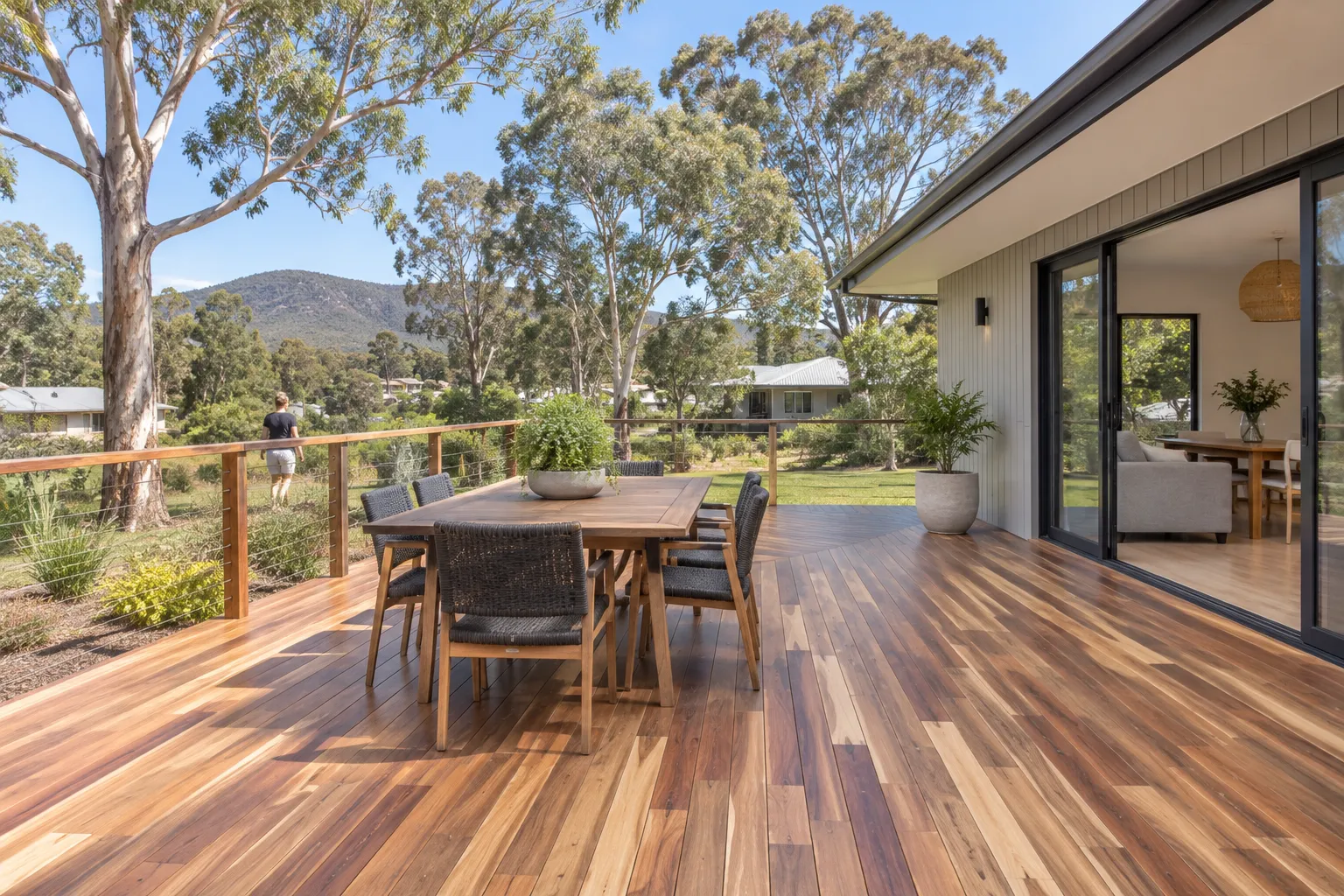
Spotted gum decking is most commonly sold as 86 by 19 millimetres and 135 by 19 millimetres, often called 90 and 140 millimetre boards, in random lengths, with thicker boards such as 135 by 32 millimetres for stair treads and wider joist spans. The 19 millimetre thickness suits standard 450 millimetre joist spacing. Grades run from select, with few marks, to standard and feature grades with more natural character. For spotted gum costs, durability and bushfire rating, see our main spotted gum decking page.
What widths does spotted gum decking come in?
The two common widths are about 86 millimetres and about 135 millimetres. Suppliers often call them 90 and 140, which are nominal sizes: the dressed board is a little narrower. Some suppliers also offer wider or narrower profiles. The width changes the look, the movement and the labour.
| Width | Look | Movement | Labour |
|---|---|---|---|
| About 86 mm (90) | Classic, finer lines | Less cupping | More boards and screws |
| About 135 mm (140) | Wide, modern | More movement across the width | Faster to lay |
In Albury's swing between wet winters and dry summers, narrower boards move less across their width, which is why many builders prefer them on low or exposed decks.
What thickness is spotted gum decking?
Most spotted gum decking is 19 millimetres thick, which suits joists at 450 millimetre centres. Thicker boards, such as 32 millimetres, are used for stair treads, wider joist spacing and commercial decks. Thicker boards are stiffer and feel more solid underfoot, but cost more and are heavier to handle.
What lengths does spotted gum come in?
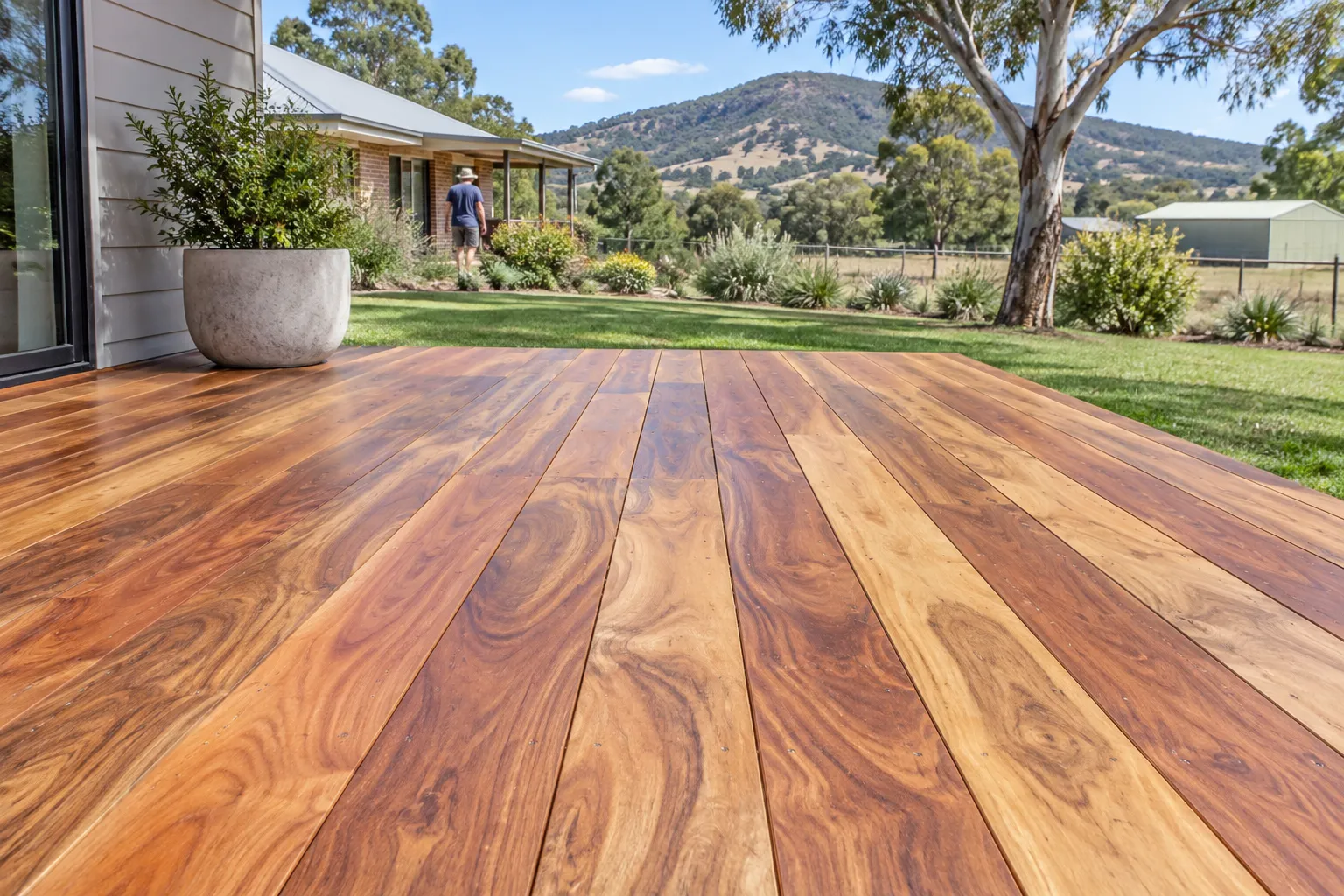
Spotted gum decking is usually sold in random lengths, often from about 1.8 to 5.4 metres or more, depending on the supplier and the grade. Longer lengths mean fewer joins across the deck, which looks cleaner. Planning the deck around the lengths available reduces waste and joins. Each join should land on a joist.
What grades of spotted gum are there?
Spotted gum is sold in grades that describe how many natural features each board has. Select grade has the fewest gum veins, knots and marks and looks cleanest. Standard grade allows more. Feature grade has the most character. All grades are equally durable, because durability comes from the heartwood, not the appearance.
| Grade | Appearance | Suits |
|---|---|---|
| Select | Clean, few marks | Feature decks, modern homes |
| Standard | Some gum veins and marks | Most backyards |
| Feature | Lots of character | Rustic look, lower cost |
Spotted gum's natural colour varies from cream to brown in every grade. See spotted gum decking problems for what's normal.
How many lineal metres of decking do you need per square metre?
Divide 1,000 by the board width plus the gap, in millimetres. With a 4 millimetre gap, 86 millimetre boards need roughly 11.1 lineal metres per square metre, and 135 millimetre boards roughly 7.2. Multiply by the deck's area, then add about 10% for offcuts and waste.
A worked example for a 20 square metre deck:
| Board | Lineal metres per m2 (approx.) | For 20 m2, plus 10% |
|---|---|---|
| 86 mm with 4 mm gap | 11.1 | About 245 m |
| 135 mm with 4 mm gap | 7.2 | About 158 m |
A builder supplying the boards will do this as part of the quote. For costs, see spotted gum decking cost.
What colours does hardwood decking come in?
Australian hardwoods range from pale to dark. Blackbutt is pale golden, spotted gum varies from cream to brown, merbau is red-brown, and ironbark is dark red-brown. Each darkens a little with oil and goes silver grey if left unoiled. Tinted oils can shift the colour warmer or more even. See stain deck colours.
Which size suits which deck?
For low decks close to the ground, narrower 86 millimetre boards are often the safer choice, because they cup less. For large, well-ventilated decks where you want a modern look and faster laying, 135 millimetre boards suit. For stairs and decks with wider joist spacing, thicker boards make sense.
For timber comparisons, see blackbutt vs spotted gum decking.
Questions people ask
What is the standard size of spotted gum decking?
The most common sizes are about 86 by 19 millimetres and 135 by 19 millimetres, sold as 90 and 140 millimetre boards, in random lengths. Thicker boards, around 32 millimetres, are available for stairs and wider spans. Sizes vary slightly between suppliers, so check the actual dressed size before planning.
Is 140 or 90 millimetre decking better?
Neither is better overall. 140 millimetre boards lay faster and give a wide, modern look. 90 millimetre boards move less, cup less and give a finer, classic look, but take more boards and screws. On low or exposed decks in Albury's climate, many builders prefer the narrower boards.
Does the grade affect how long spotted gum lasts?
No. Durability comes from the heartwood, and all grades are spotted gum heartwood. Grade describes appearance: how many gum veins, knots and marks a board has. Feature grade lasts just as long as select. Choose the grade for the look you want and your budget.
What joist spacing does 19 millimetre spotted gum need?
Joists at 450 millimetre centres are common for 19 millimetre hardwood boards like spotted gum. Diagonal layouts need closer spacing, because each board spans further between joists. Thicker boards can span further. The board supplier's guidance and the builder's span tables set the final spacing.
For the wider picture, start with the deck builder guide for Albury.
Where these facts come from
Updated